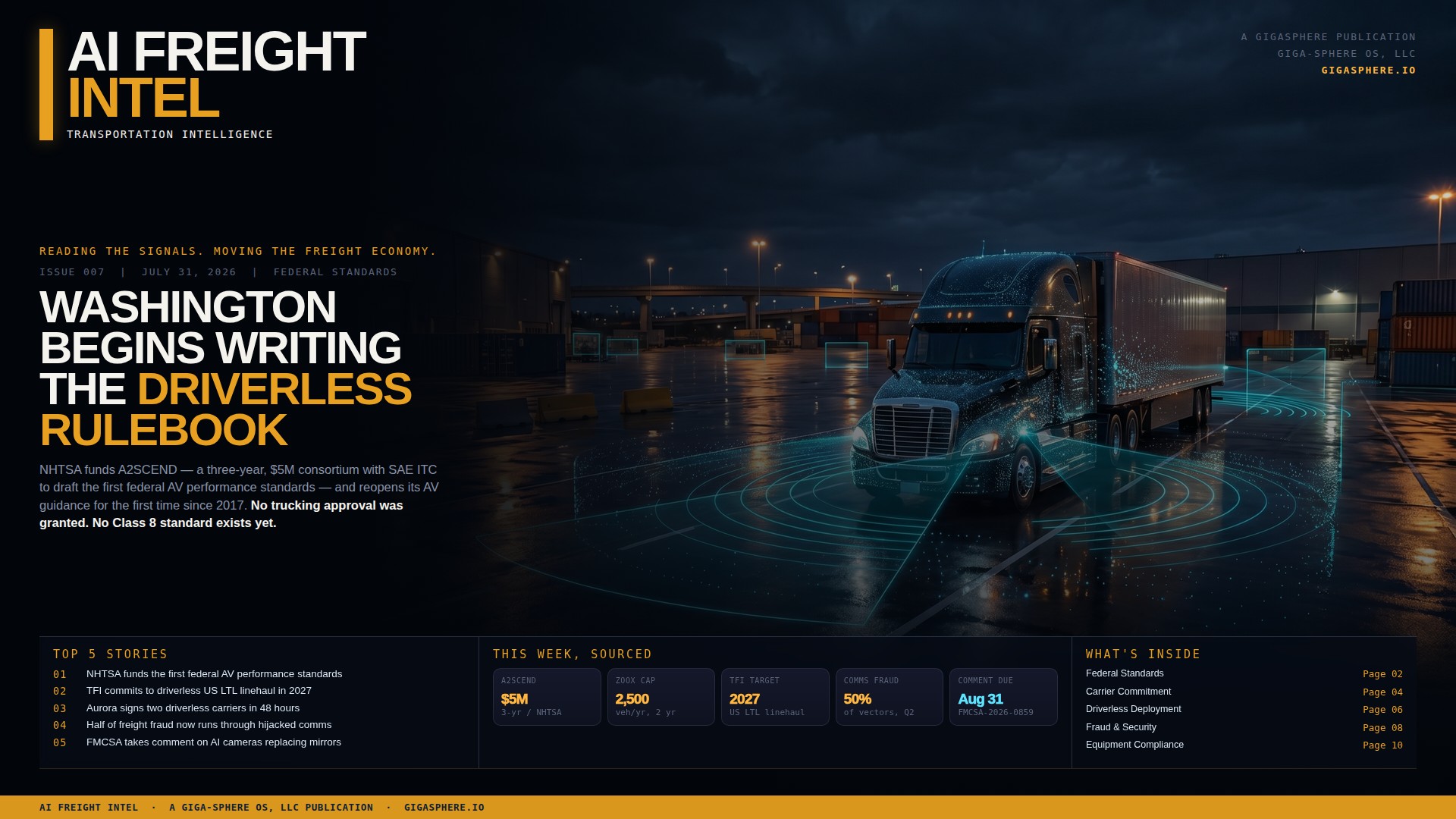
NHTSA took five actions on July 30 that together move federal autonomous-vehicle policy away from case-by-case exemptions and toward an actual performance-standards architecture. The headline action — the first commercial exemption from Federal Motor Vehicle Safety Standards for a purpose-built vehicle with no steering wheel or pedals — went to Zoox, and it is a passenger robotaxi approval, not a freight approval. No autonomous truck received anything on July 30, no Class 8 vehicle was exempted, and no federal standard for autonomous trucks exists today. What matters for freight is the other four actions, and they matter more than the one that made the wires.
What Changed?
Five simultaneous NHTSA actions, all dated July 30, 2026.
One. A temporary exemption allowing Zoox to commercially deploy up to 2,500 vehicles annually for two years, spanning eight FMVSS, under what the agency describes as an adaptable oversight structure. First-ever commercial FMVSS exemption for a purpose-built vehicle with no steering wheel or pedals.
Two. A three-year, $5 million consortium with SAE Industry Technologies Consortia, named A2SCEND, to build the first federal AV performance standards. NHTSA frames it as replacing the state-by-state patchwork with a single national standard, and states it has “initiated development of the world’s first standards for AV performance that can meet the Vehicle Safety Act’s strict objectivity requirements.”
Three. An interim final rule making vehicles manufactured before an exemption is granted eligible for commercial-deployment exemptions.
Four. A streamlined Part 555 exemption process, with updated guidance and a public feedback channel.
Five. A new federal docket opening the first update to NHTSA’s AV development and deployment guidance since 2017, scoped to emergency-responder interaction, safety management systems, remote assistance, and post-crash behavior.
Separately disclosed in the same release: an exemption application from Robomart, Inc. for a driverless low-speed delivery vehicle under FMVSS No. 500 is under review. That one is goods movement, and almost nobody covered it.
Why It Matters
Until July 30, federal AV policy was a queue. A company applied, the agency deliberated, and the answer applied to that company. That does not scale, it does not survive legal challenge, and it gives no one a target to build against.
A2SCEND is the machinery for converting agency discretion into objective, measurable standards. That is the floor an ADS-equipped Class 8 truck will eventually have to certify against — which means the rules for autonomous freight are being drafted now, by a named consortium, on a three-year clock, before most of the industry has noticed.
The Part 555 interim final rule is the unglamorous one and it is real money. A developer can now build fleet inventory ahead of approval instead of after it. That changes capital timing for every AV developer, including the truck developers.
The guidance docket is the channel. Emergency-responder interaction, remote assistance and post-crash behavior are precisely the three areas most likely to produce operating constraints on driverless freight lanes — and they are now an open federal file rather than agency jawboning.
Who Is Affected
- Every AV developer, including the truck developers — Aurora, Kodiak, Plus, Waabi, Bot Auto, Torc.
- Autonomous-truck carriers and the shippers buying that capacity.
- State AV regulators, who are the explicit target of the “single national standard” framing and face eventual federal preemption.
- First-responder agencies, whose operational experience is the subject of the new guidance docket.
- Insurers and freight-tech capital markets, who price regulatory certainty.
What To Watch
- The A2SCEND docket number, once it posts. That file becomes a standing primary source.
- Who leads the consortium. A2SCEND has $5 million, a three-year mandate and no organizational page yet — whoever runs it will be the most-quoted source on national AV standards through 2029.
- Whether the first draft standards are trucking-inclusive from the start or robotaxi-first. That single choice determines whether autonomous freight gets a federal path or waits for a second round.
- Any response from OOIDA or ATA. Neither had commented on the package as of our July 30 cutoff.
- The Robomart FMVSS No. 500 review — a driverless low-speed goods vehicle is closer to freight than the Zoox headline is.
Action To Consider
- If you operate, finance, insure or buy autonomous capacity, put the AV guidance docket on a calendar the day its number posts. Comment files close, and this one covers post-crash and first-responder expectations that will land on operators, not on developers.
- If you are a fleet with no autonomy plans at all, the item to track is still A2SCEND — because a national performance standard eventually becomes the baseline your insurer, your shipper and your roadside inspector all reference.
Plain English
The federal government has spent years saying yes or no to individual self-driving companies one at a time. This week it started writing an actual rulebook instead, and hired a standards organization to help write it. It also gave one robotaxi company — not a trucking company — permission to sell rides in a vehicle with no steering wheel.
The rulebook does not exist yet. It will take years. But the drafting has started, and the drafting is where the decisions get made.
Meaning For People Moving Freight
Nothing changed on your truck this week. No autonomous truck was approved, no lane opened, no rule took effect.
What changed is that the standard your future competition will certify against went from “someday, somehow” to a funded three-year program with a name. When that standard arrives it will decide what an autonomous truck has to prove before it can run next to you — how it behaves at a crash scene, what happens when the remote operator loses signal, whether it has to yield to a fire truck the way you do.
Those questions are being answered in a docket right now, and the people who show up in dockets are the people whose experience ends up in the rule. Drivers have the operational knowledge this process most needs and are the least represented in it.
What Remains Uncertain
- The A2SCEND docket number, consortium leadership, governance structure and timeline to a first draft standard are all unpublished.
- We could not fetch regulations.gov or reginfo.gov during this cycle. No claim about the contents of any docket appears in this issue, including the FMVSS 135 ADS brake-pedal comment record (docket NHTSA-2026-0728), whose comment period closed July 27. We do not know who commented or what they said, and we are not going to guess.
- No standalone rulemaking number for the “behavioral competencies” program was independently confirmed. The July 30 release is our corroborating source for that program's existence and status.
Sources
- NHTSA — “Cutting Red Tape to Safely Fast-Track Automated Vehicle Innovation” (primary, read in full)
https://www.nhtsa.gov/press-releases/cutting-red-tape-safely-fast-track-automated-vehicle - Reuters exclusive via U.S. News — Zoox wins first US approval for paid robotaxis with no human controls
https://money.usnews.com/investing/news/articles/2026-07-30/exclusive-amazons-zoox-wins-first-us-approval-for-paid-robotaxis-with-no-human-controls - Claims Journal, July 30, 2026
https://www.claimsjournal.com/news/national/2026/07/30/339187.htm - Carrier Management, July 30, 2026
https://www.carriermanagement.com/news/2026/07/30/290564.htm - InsideEVs, July 30, 2026
https://insideevs.com/news/803262/zoox-robotaxi-pod-cleared-for-paid-rides-nhtsa/