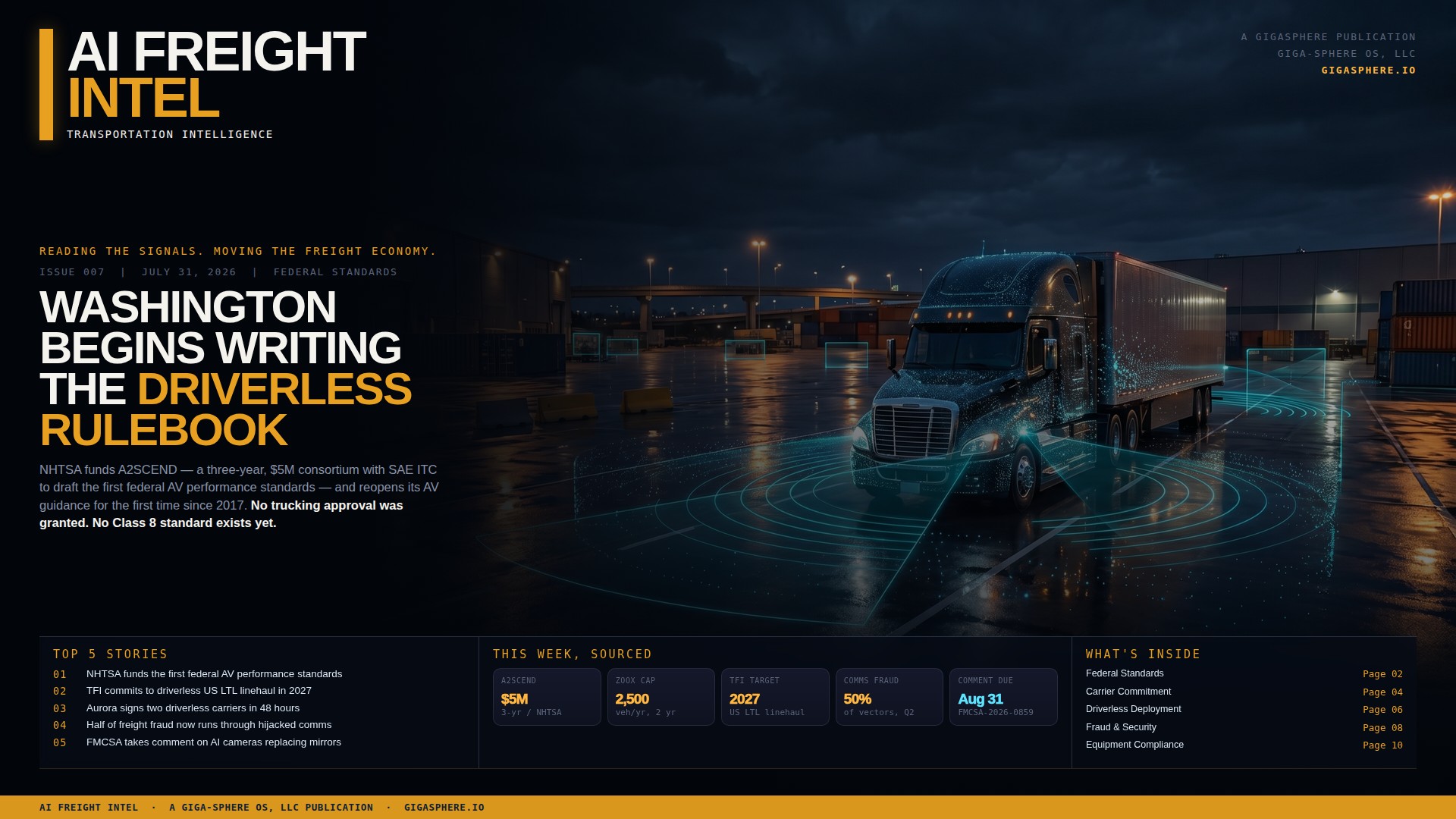
AI Freight Intel Issue 007 cover: Washington Begins Writing the Driverless Rulebook
Issue 007 · July 31, 2026 · Federal Standards

Issue 007  ·  July 31, 2026  ·  Weekly Transportation Intelligence

Washington Begins Writing the Driverless Rulebook

NHTSA funds A2SCEND — a three-year, $5M consortium with SAE ITC to draft the first federal AV performance standards — and reopens its AV guidance for the first time since 2017. No trucking approval was granted. No Class 8 standard exists yet.

Research window July 23 – July 30, 2026  ·  Exactly five stories

The Five Stories

Every story answers the same seven questions, in full.

01  ·  Federal Standards  ·  Page 02

Washington Begins Writing the Driverless Rulebook

NHTSA funded a three-year consortium to draft the first federal autonomous-vehicle performance standards, streamlined the exemption process, and reopened its AV guidance for the first time since 2017. The headline approval went to a passenger robotaxi — the freight consequence is everything underneath it.

Governance — federal standards
02  ·  Carrier Commitment  ·  Page 04

A Top-Tier LTL Carrier Just Put a Year on Driver-Out Linehaul

TFI International told analysts it will run autonomous trucks in its US less-than-truckload linehaul network in 2027. It will not say who is supplying the trucks — and the structure it chose is more interesting than the date.

Autonomy — carrier adoption
03  ·  Driverless Deployment  ·  Page 06

Two Carriers Signed for Driverless in 48 Hours — and One of Them Put Pharma on the Truck

Aurora added Value Truck and Charger Logistics on consecutive days, both concentrating on the Dallas–Laredo corridor. The freight mix is the part worth noticing.

Autonomy — commercial deployment
04  ·  Fraud & Security  ·  Page 08

Half of Freight Fraud Now Arrives Through a Hijacked Inbox or a Spoofed Phone Call

Communication-based attacks reached 50% of classified fraud vectors in the second quarter. The more important number is the one moving the other way.

Cybersecurity and freight fraud
05  ·  Equipment Compliance  ·  Page 10

FMCSA Is Taking Comment on Letting an AI Camera Replace Your Mirrors

A five-year exemption request would let carriers run commercial vehicles with a camera monitor system instead of the two mirrors federal rules require. Comments close August 31. We found no other outlet reporting it.

Governance — freight-native

Federal Standards  ·  Story 1 of 5  ·  Page 02

Washington Begins Writing the Driverless Rulebook

NHTSA funded a three-year consortium to draft the first federal autonomous-vehicle performance standards, streamlined the exemption process, and reopened its AV guidance for the first time since 2017. The headline approval went to a passenger robotaxi — the freight consequence is everything underneath it.

NHTSA took five actions on July 30 that together move federal autonomous-vehicle policy away from case-by-case exemptions and toward an actual performance-standards architecture. The headline action — the first commercial exemption from Federal Motor Vehicle Safety Standards for a purpose-built vehicle with no steering wheel or pedals — went to Zoox, and it is a passenger robotaxi approval, not a freight approval. No autonomous truck received anything on July 30, no Class 8 vehicle was exempted, and no federal standard for autonomous trucks exists today. What matters for freight is the other four actions, and they matter more than the one that made the wires.

What Changed?

Five simultaneous NHTSA actions, all dated July 30, 2026.

One. A temporary exemption allowing Zoox to commercially deploy up to 2,500 vehicles annually for two years, spanning eight FMVSS, under what the agency describes as an adaptable oversight structure. First-ever commercial FMVSS exemption for a purpose-built vehicle with no steering wheel or pedals.

Two. A three-year, $5 million consortium with SAE Industry Technologies Consortia, named A2SCEND, to build the first federal AV performance standards. NHTSA frames it as replacing the state-by-state patchwork with a single national standard, and states it has “initiated development of the world’s first standards for AV performance that can meet the Vehicle Safety Act’s strict objectivity requirements.”

Three. An interim final rule making vehicles manufactured before an exemption is granted eligible for commercial-deployment exemptions.

Four. A streamlined Part 555 exemption process, with updated guidance and a public feedback channel.

Five. A new federal docket opening the first update to NHTSA’s AV development and deployment guidance since 2017, scoped to emergency-responder interaction, safety management systems, remote assistance, and post-crash behavior.

Separately disclosed in the same release: an exemption application from Robomart, Inc. for a driverless low-speed delivery vehicle under FMVSS No. 500 is under review. That one is goods movement, and almost nobody covered it.

Why It Matters

Until July 30, federal AV policy was a queue. A company applied, the agency deliberated, and the answer applied to that company. That does not scale, it does not survive legal challenge, and it gives no one a target to build against.

A2SCEND is the machinery for converting agency discretion into objective, measurable standards. That is the floor an ADS-equipped Class 8 truck will eventually have to certify against — which means the rules for autonomous freight are being drafted now, by a named consortium, on a three-year clock, before most of the industry has noticed.

The Part 555 interim final rule is the unglamorous one and it is real money. A developer can now build fleet inventory ahead of approval instead of after it. That changes capital timing for every AV developer, including the truck developers.

The guidance docket is the channel. Emergency-responder interaction, remote assistance and post-crash behavior are precisely the three areas most likely to produce operating constraints on driverless freight lanes — and they are now an open federal file rather than agency jawboning.

Who Is Affected

  • Every AV developer, including the truck developers — Aurora, Kodiak, Plus, Waabi, Bot Auto, Torc.
  • Autonomous-truck carriers and the shippers buying that capacity.
  • State AV regulators, who are the explicit target of the “single national standard” framing and face eventual federal preemption.
  • First-responder agencies, whose operational experience is the subject of the new guidance docket.
  • Insurers and freight-tech capital markets, who price regulatory certainty.

What To Watch

  • The A2SCEND docket number, once it posts. That file becomes a standing primary source.
  • Who leads the consortium. A2SCEND has $5 million, a three-year mandate and no organizational page yet — whoever runs it will be the most-quoted source on national AV standards through 2029.
  • Whether the first draft standards are trucking-inclusive from the start or robotaxi-first. That single choice determines whether autonomous freight gets a federal path or waits for a second round.
  • Any response from OOIDA or ATA. Neither had commented on the package as of our July 30 cutoff.
  • The Robomart FMVSS No. 500 review — a driverless low-speed goods vehicle is closer to freight than the Zoox headline is.

Action To Consider

  • If you operate, finance, insure or buy autonomous capacity, put the AV guidance docket on a calendar the day its number posts. Comment files close, and this one covers post-crash and first-responder expectations that will land on operators, not on developers.
  • If you are a fleet with no autonomy plans at all, the item to track is still A2SCEND — because a national performance standard eventually becomes the baseline your insurer, your shipper and your roadside inspector all reference.

Plain English

The federal government has spent years saying yes or no to individual self-driving companies one at a time. This week it started writing an actual rulebook instead, and hired a standards organization to help write it. It also gave one robotaxi company — not a trucking company — permission to sell rides in a vehicle with no steering wheel.

The rulebook does not exist yet. It will take years. But the drafting has started, and the drafting is where the decisions get made.

Meaning For People Moving Freight

Nothing changed on your truck this week. No autonomous truck was approved, no lane opened, no rule took effect.

What changed is that the standard your future competition will certify against went from “someday, somehow” to a funded three-year program with a name. When that standard arrives it will decide what an autonomous truck has to prove before it can run next to you — how it behaves at a crash scene, what happens when the remote operator loses signal, whether it has to yield to a fire truck the way you do.

Those questions are being answered in a docket right now, and the people who show up in dockets are the people whose experience ends up in the rule. Drivers have the operational knowledge this process most needs and are the least represented in it.

What Remains Uncertain

  • The A2SCEND docket number, consortium leadership, governance structure and timeline to a first draft standard are all unpublished.
  • We could not fetch regulations.gov or reginfo.gov during this cycle. No claim about the contents of any docket appears in this issue, including the FMVSS 135 ADS brake-pedal comment record (docket NHTSA-2026-0728), whose comment period closed July 27. We do not know who commented or what they said, and we are not going to guess.
  • No standalone rulemaking number for the “behavioral competencies” program was independently confirmed. The July 30 release is our corroborating source for that program's existence and status.

Sources

Carrier Commitment  ·  Story 2 of 5  ·  Page 04

A Top-Tier LTL Carrier Just Put a Year on Driver-Out Linehaul

TFI International told analysts it will run autonomous trucks in its US less-than-truckload linehaul network in 2027. It will not say who is supplying the trucks — and the structure it chose is more interesting than the date.

On its second-quarter earnings call on July 27, TFI International CFO David Saperstein told analysts the company plans to deploy autonomous trucks in its US LTL linehaul business in 2027, with testing beginning within months. This is a stated commitment on an earnings call. It is not a deployment. No partner was named, no truck count given, no lane identified, no contract disclosed and no capital committed on the record.

What Changed?

TFI put a calendar year on driver-out LTL linehaul. No top-tier North American LTL operator had done that publicly before.

The structure is the detail worth reading twice: TFI expects to initially broker freight to the AV provider, which will operate the vehicles. If the program performs, TFI would then consider buying the technology for new trucks the following year.

Saperstein’s stated rationale, in his words, is that the equipment “can drive day and night, there’s no hours of service” — plus smoother acceleration and braking for fuel economy, and reduced exposure to driver turnover.

He also said the technology could spur industry consolidation. That sentence is the strategic signal, not the deployment date.

Context from the same quarter: TFI LTL shipments rose 7.5% year over year to 1.97 million.

Why It Matters

LTL linehaul is the highest-value autonomous use case that nobody had publicly committed to. It is fixed, repeatable, terminal-to-terminal, runs overnight, and it is exactly where the hours-of-service constraint costs the most. If driver-out works anywhere in trucking first, structurally it should be here.

The broker-first structure is the part other carriers can copy tomorrow. TFI is buying capacity, not assets: no capital expenditure, no maintenance liability, no insurance restructuring, no fleet on the balance sheet, and a clean exit if the program disappoints. That is a template, and templates spread faster than announcements.

The consolidation remark tells you how TFI is thinking. If autonomous linehaul lowers cost per mile for whoever adopts it first, the operators who cannot follow become acquisition targets. That is a prediction about market structure from a company that has grown substantially by acquisition.

Who Is Affected

  • The US LTL market — XPO, Saia, Old Dominion, Estes — all of whom will now be asked about this on their own calls.
  • LTL linehaul drivers, the most directly exposed workforce in the announcement.
  • The autonomous-truck developers competing for the contract.
  • LTL shippers, who will eventually be quoted rates built on a different cost structure.

What To Watch

  • Who the partner is. The field is narrow — Aurora, Kodiak, Plus, Torc, Waabi, Bot Auto. An LTL-linehaul driver-out contract would be a first for whichever one it is.
  • Whether testing actually begins “within months,” as stated. That is the first checkable milestone.
  • Whether any competing LTL carrier answers with its own date, and how fast. Silence is also an answer.
  • Whether the broker-first structure holds, or whether TFI moves to ownership sooner than the stated following year.

Action To Consider

  • If you run LTL linehaul, the planning question is not 2027. It is what your network looks like if a competitor removes the hours-of-service ceiling from a subset of its lanes and you have not.
  • If you drive LTL linehaul, this is a stated intent with no truck count and no lane — but it is the first time a major carrier has named a year, and it is worth asking your employer directly what their position is rather than waiting to read it on a transcript.
  • For anyone tracking this: TFI IR can be asked who the partner is. Saperstein said it publicly on a recorded call, which makes it a fair question.

Plain English

One of the biggest trucking companies in North America told investors it plans to have trucks with no driver hauling freight between its own terminals in 2027. It will start by paying somebody else to run those trucks rather than buying them.

It has not said which company. It has not said how many trucks or on which roads. Nothing is running yet, and testing has not started.

Meaning For People Moving Freight

The reason a company gives for doing something usually tells you more than the announcement. TFI’s stated reason was hours of service — that a machine runs day and night and a person legally cannot.

That is a straightforward statement about what the equipment does. It is also the clearest public acknowledgment yet that the economic case for driver-out linehaul is built directly on the safety rule that governs human drivers.

For LTL linehaul drivers, the honest read is this: nothing changes in 2026, a test may start in 2027, and the company has structured the deal so it can walk away cheaply. But your employer’s competitor has now said the quiet part on a recorded call, and the follow-up question — what is our plan — is a reasonable one to ask out loud.

What Remains Uncertain

  • The AV partner is not named. No truck count, no lane, no contract terms, no capital figure.
  • There is a minor source conflict on the call date — Transport Topics reports July 27, wire coverage carried it July 28. Both fall inside our research window.
  • Everything here is a statement of intent made on an earnings call. We have verified that the statement was made and that multiple independent outlets report it consistently. We have not verified that anything will happen.

Sources

Driverless Deployment  ·  Story 3 of 5  ·  Page 06

Two Carriers Signed for Driverless in 48 Hours — and One of Them Put Pharma on the Truck

Aurora added Value Truck and Charger Logistics on consecutive days, both concentrating on the Dallas–Laredo corridor. The freight mix is the part worth noticing.

Aurora Innovation signed two carrier customers in two days. Value Truck, a Phoenix carrier with a US/Mexico terminal network, on July 27, for Dallas–Laredo and Fort Worth–Phoenix. Charger Logistics, of Brampton, Ontario, on July 28, for Dallas–Laredo, hauling refrigerated food and pharmaceuticals. Both begin as supervised trips in the third quarter and are expected to transition to daily driverless trips in the fourth. Aurora’s second-generation truck platform launched on July 22 and was the lead story of Issue 006 — that launch is not new, and we are not re-reporting it. What is new is who signed.

Aurora’s second-generation truck platform launched July 22, 2026 and was the lead story of Issue 006. It is referenced here only as background. This story covers the two customer agreements and the Q2 guidance, both of which are new.

What Changed?

Two customer agreements on consecutive days on a platform released five days earlier.

Value Truck (July 27, 9:00 a.m. EDT): Dallas–Laredo and Fort Worth–Phoenix, framed as adding around-the-clock long-haul capacity while redeploying its own drivers to local freight.

Charger Logistics (July 28): Dallas–Laredo, described as one of its busiest US corridors, carrying refrigerated food and pharmaceuticals.

For both customers, the routes begin as supervised trips in Q3 and are expected to transition to daily driverless trips in Q4.

Supporting context from Aurora’s Q2 results on July 29 — all figures company-stated and unaudited: guidance of 20–25 driverless trucks in operation by the end of Q3 2026, 200+ by year-end, and roughly $80 million in trucking-as-a-service revenue run-rate exiting the year. Aurora also reported approximately 440,000 cumulative driverless miles through the end of June, with 100% on-time performance and no collisions it attributes to the Aurora Driver. Q2 revenue was $2 million against a net loss of roughly $270 million. CEO Chris Urmson described the second-generation platform as “the start of our commercial scaling phase.”

Why It Matters

Two signings in two days on a newly released platform is a cadence signal. It suggests Aurora has moved past bespoke pilot partnerships negotiated one at a time and into a repeatable driver-as-a-service sales motion. Cadence, not any single customer, is the metric.

Both customers chose Laredo — the busiest land port in the Western Hemisphere and roughly 40% of US–Mexico freight. Aurora is concentrating lane density on a nearshoring corridor rather than spreading across the map. Density is what determines whether driverless unit economics work at all: more trucks on fewer lanes means shared terminals, shared support, shared mapping.

Refrigerated food and pharmaceuticals on a driverless lane is a materially higher-stakes commitment than dry van. Temperature excursion and chain-of-custody exposure on pharma freight are not hypothetical costs. A carrier putting that freight on the lane is making a statement about its own risk assessment.

Aurora’s Q2 guidance converts the autonomy story from miles-driven public relations into a countable target. 200 trucks by December is checkable in December. AI Freight Intel has logged it and will check it.

Who Is Affected

  • Cross-border and nearshoring shippers, particularly on US–Mexico lanes.
  • Laredo-corridor capacity and the drayage and terminal operators around it.
  • Truckload drivers running Dallas–Laredo and Fort Worth–Phoenix.
  • Competing AV developers — Kodiak, Waabi, Gatik, Plus, Bot Auto — who now have a customer-acquisition cadence to be measured against.

What To Watch

  • Whether the Q4 driverless transition actually happens on schedule for both customers, or slips.
  • Whether Aurora hits 20–25 trucks by the end of Q3. That is the near-term falsifiable number.
  • Whether the next signings also cluster on Laredo, or whether Aurora starts a second density corridor.
  • The NHTSA Standing General Order crash-reporting database, which is the independent cross-check on Aurora’s collision claim. We are standing that up as a recurring verification routine rather than a one-off.

Action To Consider

  • If you run Dallas–Laredo or Fort Worth–Phoenix, these are your lanes. Supervised trips start this quarter. Expect to share the road with a supervised autonomous truck before you share it with an unsupervised one.
  • If you are a shipper evaluating driverless capacity, the question to ask is not miles driven. It is lane density, terminal support and what the contract says about liability — none of which has been disclosed here.

Plain English

A self-driving truck company signed up two trucking companies in two days to use its trucks. Both chose the same route between Dallas and Laredo, Texas. One of them will use those trucks to carry refrigerated food and medicine.

For now a human safety driver sits in the seat. The plan is to remove that person later this year. Neither company said how many trucks, what it costs, or what happens if something goes wrong.

Meaning For People Moving Freight

This is the week the driverless story stopped being about the trucks and started being about the freight. Dry van is one thing. Reefer and pharma mean a carrier has looked at the claims exposure and signed anyway.

If you run these lanes, the practical near-term change is that you will see supervised autonomous trucks on them this quarter, with a person still behind the wheel. The unsupervised version is a stated plan for Q4, not a fact.

The number to hold everyone to is 200 trucks by December. Not 200 someday — 200 by December, said out loud on an earnings call. In December, either it happened or it did not, and that will tell you more about the pace of this than any announcement between now and then.

What Remains Uncertain

  • No truck counts, contract values, contract terms or lane volumes were disclosed for either customer. Trucking Dive noted this explicitly.
  • Aurora’s 440,000 driverless miles, 100% on-time performance and collision record are all self-reported with no third-party audit. “No collisions attributed to the Aurora Driver” uses a denominator Aurora defines itself, and does not mean zero collisions.
  • Both announcements are forward-looking. Aurora’s own disclaimer warns that anticipated customer orders may not materialize, may be delayed, or may be cancelled.
  • The Roush figure of 1,000 trucks per year is a stated manufacturing capability, not units built.

Sources

Fraud & Security  ·  Story 4 of 5  ·  Page 08

Half of Freight Fraud Now Arrives Through a Hijacked Inbox or a Spoofed Phone Call

Communication-based attacks reached 50% of classified fraud vectors in the second quarter. The more important number is the one moving the other way.

Carrier-identity provider Highway published its Q2 2026 Freight Fraud Index on July 28. Its central finding: communication-based attacks — compromised inboxes, spoofed email, account takeover and impersonation calls — reached 50% of all classified fraud vectors in Q2, up from 42.7% in Q1. Read that figure knowing who produced it: Highway sells carrier-identity and fraud-prevention software, the data is its own unaudited network telemetry, and it is measuring a problem it also sells the fix for. We are using the ratio and the direction, and not the absolute counts, for exactly that reason.

Commercial-interest disclosure. Highway is a carrier-identity and fraud-prevention vendor. Every number in this story is its own unaudited telemetry, and it sells the product that mitigates the problem it measures. AI Freight Intel has no commercial relationship with Highway. We have used the ratio shift and the ownership divergence, and deliberately not the absolute counts.

What Changed?

Communication-based attacks moved from 42.7% of classified fraud vectors in Q1 to 50% in Q2 — from under half to half.

The finding underneath it is more useful than the headline: ownership-change fraud rose to 25.6% of reported thefts from 23.0%, while ownership-discrepancy alerts fell 40.9%. The loss category grew while the control that is supposed to catch it went quiet.

Highway also reports blocking 784,201 fraudulent inbound emails and intercepting 109,995 spoofed or fraudulent calls in the quarter, and says impersonation of its own brand rose 282% quarter over quarter. Those are counts of Highway’s own blocking activity across its own customer base. They rise when Highway signs customers as well as when attackers get busier, and they are not an industry measurement. We are reporting that they exist, not what they prove.

Highway shipped a control it calls Ownership Attestation during the quarter — relevant context for reading the alert numbers, and another reason to treat this as a vendor document.

Why It Matters

There is a coherent explanation for the shift, and it is regulatory. FMCSA’s Motus registration transition went live May 14, 2026, IDEMIA identity verification raised the cost of establishing a new carrier identity, and 15 ELD providers were decertified in Q2.

When creating a fake carrier gets expensive, the attack moves to taking over a real one. That is the thesis this quarter’s data supports: as identity creation got harder, fraud migrated to identity takeover.

It reframes what protects you. Registration screening was the control that mattered when the threat was fake carriers. It is not the control that matters when the threat is a real, verified, screened carrier whose email account someone else is reading.

The divergence is the tell. A detection control getting quieter while the loss category it governs grows is a detection-gap problem, not a fraud-volume problem — and detection gaps are where losses accumulate silently.

Who Is Affected

  • Freight brokers and 3PLs, whose inboxes are the attack surface.
  • Motor carriers and owner-operators, whose identities are the thing being taken over.
  • Shippers and cargo insurers absorbing the loss.
  • Carrier-vetting vendors generally — Highway, Descartes MyCarrierPortal, Truckstop RMIS, DAT, Bluewire — all of whom now have a shared problem to answer for.

What To Watch

  • Whether the ownership-alert decline reverses in Q3. If it does not, the detection gap is structural rather than a reporting artifact.
  • Whether any independent dataset corroborates the direction. Bluewire publishes a carrier score built on 652,000+ evaluations across 47 consecutive monthly releases and is the obvious cross-check.
  • Verisk CargoNet’s quarterly theft data, which has flagged an underreported mechanism: compromise of software-based business phone systems, letting a remote actor place calls from a carrier’s own verified numbers.

Action To Consider

  • Treat any mid-transaction change to payment, remit-to, ownership or contact details as hostile until you have verified it out of band. Not by replying to the message. Not by calling the number in the message.
  • Call back on a number you already had on file from before the transaction started. Spoofed caller ID and compromised phone systems mean the number showing on your screen is not evidence of anything.
  • Turn on email authentication (SPF, DKIM, DMARC) on your own domain, and multi-factor authentication on every mailbox that touches load tendering or payment. Account takeover is the vector; the mailbox is the door.
  • If you are a small carrier or owner-operator: your MC/DOT identity is now the asset being stolen, not just your load. Check periodically that your registration contact and payment details still say what you think they say.

Plain English

Freight thieves used to invent fake trucking companies. That got harder, because the government tightened up how you register one.

So they switched. Now they break into the email of a real, legitimate trucking company or broker and steal loads using that company’s good name. Half of all the fraud counted last quarter worked this way.

The company that published these numbers sells software that blocks this kind of attack. That does not make the numbers wrong. It does mean you should read them as a vendor’s view of its own network, not as a measurement of the whole industry.

Meaning For People Moving Freight

This is the one story in this issue with something to do on Monday, and it costs nothing.

The single highest-value habit: when anything about money or ownership changes mid-deal, hang up and call back on a number you had before the deal started. That one habit defeats most of what this report describes.

For an owner-operator, the uncomfortable part is that your clean, verified, screened authority is now the thing worth stealing. The system that made it hard for criminals to be fake carriers made it valuable for them to be you.

What Remains Uncertain

  • Every figure is Highway’s own network telemetry, unaudited, measuring its own blocking activity. Highway sells the product that mitigates the problem it measures. Its counts scale with its own customer growth.
  • The 282% brand-impersonation figure is self-referential — it measures impersonation of Highway.
  • Independent directional corroboration exists in the FBI IC3 public service announcement of April 30, 2026 (approximately $725 million in cyber-enabled cargo theft in 2025, up about 60% year over year), but that PSA falls outside this issue’s research window and is cited here as context only, not as an event of this week.
  • Fraud tradecraft is not by itself an artificial-intelligence story. It qualifies here as an AI-enabled threat — synthetic communications and impersonation at scale — not as a report about an AI product.

Sources

Equipment Compliance  ·  Story 5 of 5  ·  Page 10

FMCSA Is Taking Comment on Letting an AI Camera Replace Your Mirrors

A five-year exemption request would let carriers run commercial vehicles with a camera monitor system instead of the two mirrors federal rules require. Comments close August 31. We found no other outlet reporting it.

Buried in the Federal Register on July 30 — 91 FR 48210, docket FMCSA-2026-0859 — FMCSA opened public comment on a five-year exemption from 49 CFR 393.80(a) that would let motor carriers operate commercial motor vehicles equipped with the TSI “ClearView E-Mirror” camera monitor system instead of the two rear-vision mirrors the regulation requires. This is an application under comment. FMCSA has taken no position, nothing has been granted, and denial is a live outcome.

Original reporting. We found no independent trade coverage of this notice. If you see it elsewhere after today, we got here first — and if we have missed prior coverage, tell us and we will correct this line.

What Changed?

Transit Solutions, LLC, doing business as TSI Video, applied for a five-year exemption from the mirror requirement in 49 CFR 393.80(a).

Per the notice, the ClearView E-Mirror system “uses optimized AI models for edge detection and object classification to continuously identify pedestrians and obstacles,” alerting the driver through an in-cab monitor and LED indicators.

The notice published July 30, 2026 (public inspection July 29, 8:45 a.m.), signed by Larry W. Minor, Associate Administrator for Policy. Comments are due August 31, 2026.

We searched for independent trade coverage of this notice and found none.

Why It Matters

This is a concrete test of whether FMCSA will accept an AI perception system as a legal substitute for a mandated physical safety device on a human-driven commercial truck.

It is the same substitution logic NHTSA is applying to steering wheels and brake pedals for driverless vehicles — arriving the same day, at the opposite end of the fleet, on the conventional trucks virtually every reader of this publication actually operates.

If granted, it establishes an equivalence precedent: camera plus AI is at least as good as a mirror. That has downstream consequences for mirror-delete aerodynamic tractor designs, and for how AI-based detection gets treated across FMCSR compliance generally.

It also creates a new failure mode. A mirror cannot lose power, cannot fail a software update and cannot need a firmware rollback. A camera monitor system can do all three, and a roadside inspector would have to evaluate a functioning system rather than confirm a piece of glass exists.

Who Is Affected

  • Motor carriers of every size, including owner-operators — this is FMCSR equipment law on interstate commercial vehicles.
  • Camera-monitor-system and telematics vendors, who would gain a federal precedent.
  • Truck OEMs, for whom mirror-delete designs unlock aerodynamic gains.
  • Roadside inspectors, whose job would change from confirming a mirror to evaluating a detection system.

What To Watch

  • The comment record itself after August 31, and who shows up in it. Whether OOIDA, ATA, CVSA or any driver organization files is the most informative signal available here.
  • Whether FMCSA grants, denies, or grants with conditions — conditions would be the most interesting outcome, because conditions become the template.
  • Whether any other camera-monitor vendor files a parallel application on the back of this one.

Action To Consider

  • Comment on docket FMCSA-2026-0859 before August 31, 2026. This is a rare item where an individual driver’s operational experience is directly relevant and directly admissible.
  • If you have driven a truck with a camera monitor system — in glare, in heavy rain, at night, in a snow-covered mirror-bracket situation — that is exactly the evidence this docket is short of. Vendors will file. Drivers usually do not.
  • If you spec equipment, watch this before you commit to a mirror-delete tractor order. The regulatory answer is not in yet.

Plain English

Federal rules say a big truck must have two mirrors. A camera company has asked permission to replace them with cameras and screens that use AI to spot people and obstacles, and to warn the driver.

The government has not said yes. It has not said no. It has opened a public comment period, and anyone can write in until August 31.

Meaning For People Moving Freight

This one is about your truck, not somebody’s robotaxi, and you can actually do something about it.

The argument being made to FMCSA is that a camera with AI object detection is at least as safe as a mirror. Maybe it is. Drivers are the people who know where mirrors fail and where screens fail — low sun, wet lenses, the moment a display reboots on a merge — and that knowledge is worth more in this docket than any test report.

The pattern worth noticing across this whole issue: the same week the federal government started drafting standards to replace the driver in one lane, it started taking comment on replacing the driver’s mirrors in another. Both are arguments that software perception can stand in for something physical. Only one of them has a comment box open, and it is this one.

What Remains Uncertain

  • This is a routine exemption notice, not a rulemaking. FMCSA has taken no position, has granted nothing, and denial is a live outcome.
  • There is no published timeline for a decision.
  • How a granted exemption would be enforced at roadside — what an inspector checks, and what constitutes a failed system — is not addressed in the notice.

Sources

What We Cut, and Why

Six other stories were considered and did not make the issue. We run exactly five a week.

Candidate Why it did not run
UPS Q2 2026 automation economicsCut despite outscoring two stories that ran. It was the most heavily covered item on the board, the least AI-native (automated parcel buildings are principally mechanical materials handling), the least freight-native, and its headline figure — automated buildings run about 28% lower cost per piece — is an internal comparison with no disclosed methodology. Automated buildings are systematically newer and denser, so the number may be measuring building vintage as much as automation.
C.H. Robinson Q2 2026 — “hundreds of AI agents”Tied on score with the fraud story. Cut because its central claim — a 60% cumulative productivity gain since late 2022 — has no published definition, baseline or denominator, and “hundreds of agents” is uncounted. The underlying question is a good one and we intend to come back to it with the metric defined.
Freehand raises $75M for agentic AI over Fortune 500 supply-chain spendThe strongest investment item of the week, with an unusually strong on-record named-buyer attestation. Cut for balance — five slots, and displacing a governance or deployment story with a funding round was the wrong trade.
Aurora Q2 2026 fleet guidanceNot cut — folded into Story 3. Same company; running both would have given one vendor two of five slots.
Rep. Mullin’s AV Emergency Response Coordination ActMotivated by passenger robotaxi incidents, and we could not locate a congress.gov bill number, so it can only be described as introduced and announced rather than filed and numbered. Held for a future piece on local control.
Freight Hero $5M seedNo named customer disclosed and every traction claim company-supplied.

What We Could Not Confirm

No confirmed cyberattack on US transportation infrastructure occurred in this window. Both in-window transportation leak-site listings were Malaysian. This is a genuine null result, not a search failure, and we would rather say so than fill the slot.

We did not run the L&A Transport ransomware claim. It was listed before our window opened, and across July 23–30 we found no company confirmation, no state attorney-general breach notification, no SEC filing and no follow-on coverage. Everything known about it comes from the attacker. That is not enough.

We could not fetch regulations.gov or reginfo.gov this cycle. So this issue contains no claim about the contents of any docket, including the FMVSS 135 comment record that closed July 27. We know the comment period closed. We do not know who commented, and we have not implied that we do.

This was a lighter week for qualifying material than our own bar calls for. We would rather tell you that than pad the issue out to look fuller than the week actually was.

Previous Issue

Issue 006 · July 24, 2026 →